


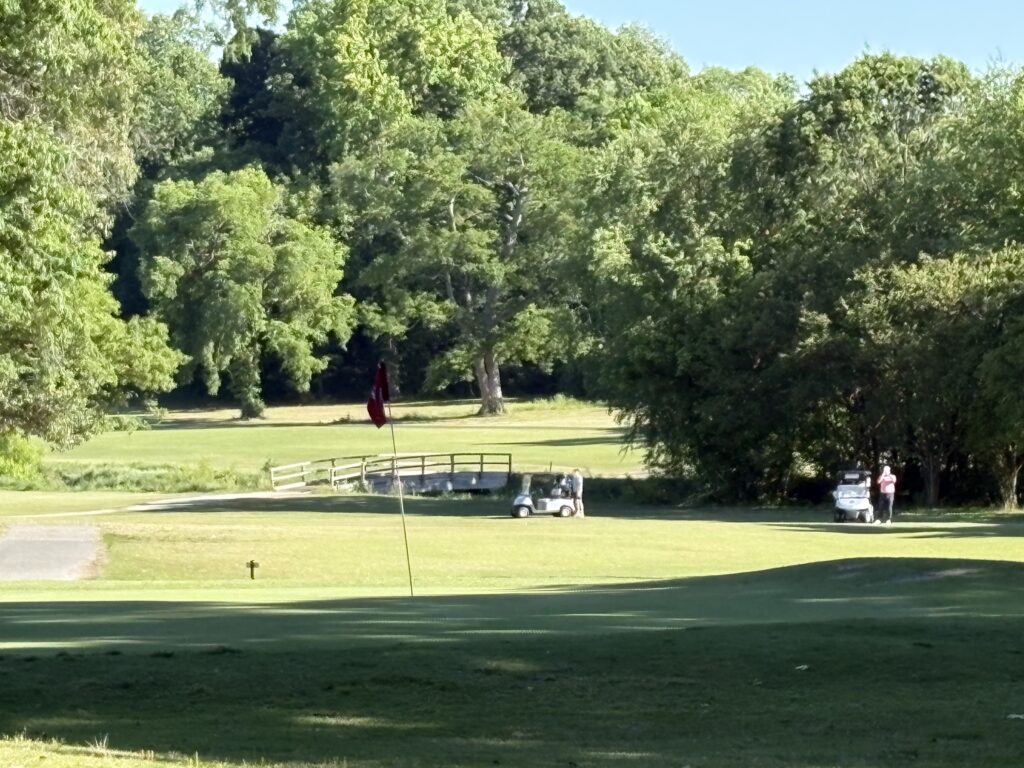
Gillespie Golf Course isn’t the fanciest golf facility in the Triad. It’s an historical, no-frills municipal golf course in a minority neighborhood bordering industrial properties.
But it might be the most important course in Greensboro.
There’s a lot to like about the nine-hole, par-36 layout only a few minutes south of downtown Greensboro. On Saturday, I made my first visit of the year to the course.
The routing is interesting, utilizing undulating terrain and a system of creeks to create a good mix of holes. The greens are small, but smooth and challenging. Despite the drought, I found well-maintained tees, fairways and greens.
Gillespie has a solid corps of regulars. The complex includes a spacious driving range, a chipping course and a practice green. The small pro shop has essentials — balls, gloves, tees and some equipment and apparel. Next to the pro shop is Par 3 Grill, a restaurant/snack bar leased out by the city.
Perhaps most appealing about Gillespie — the price. Walkers pay only $11. The price for nine holes with a cart tops out at $24 on the weekends. Seniors pay only $17 for 18 holes and a cart.
Plus, tee times are not always needed, especially in the afternoon. It’s fairly easy to walk in and either find playing partners or play by yourself. Got a couples hours free, you can typically find a play on the tee sheet.
I didn’t play at Gillespie until I’d been in the Triad for six years. Aware it was only nine holes and the prices were low, I figured it couldn’t be any good. As I’ve attempted to relay, I was wrong.
If I have limited time or want to practice, I play Gillespie. It’s not much more expensive than hitting a large bucket of balls. Plus, it’s a lot more fun. To score well, players will have to hit a variety of shots. It’s cliche, but it requires hitting most clubs.
Gillespie measures 3,322 (6,445 for 18) yards from the back tees, 3,193 (6,212) from the whites and 2,463 (5,017) from the reds. The course rating tops out at 70.5 with a 131 slope.
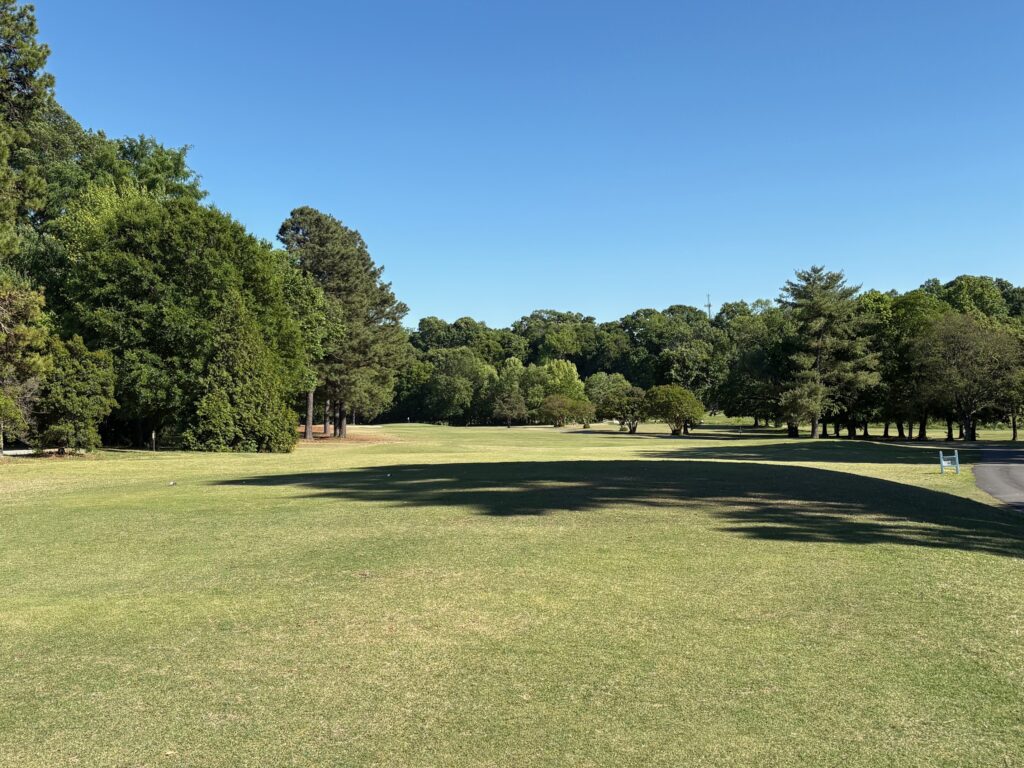
There are few starter holes better than No. 1, a short, wide-open par-4 allowing players to spray drives to the right and still have direct short irons to the green.
Players either hit draws on the dogleg-right No. 2 or face long approaches over a creek. Drives are drawn to the creek along the right side of the hole as if the water were a magnet.
The two par-5s are especially tricky, requiring precision second shots.
At the tee of the par-5 third, players must hit a solid fade over a creek. Then, an almost impossible second shot is required to the fairway sloping hard to the right and toward a creek. The only safe second shot skirts the trees on the left that will eventually fall to the low side of the fairway. The largest green on the course awaits with a steep left-to-right contour.
At the par-3 No. 4, a mid-iron is required to another dramatically sloped, small green sloping sharply off to the left that sends ball bounding off toward the driving range. Approaches hit left face a steep uphill pitch with a small target.
Nos. 5, 6 and 7 are par-4s featuring major undulations in the fairways and fast, sloping greens. At the par-3 eighth, players face a long par-3 measuring more than 200 yards from the back tees.
No. 9, a 560-yard dogleg right, requires two long accurate shots to get in position for an approach. Drives must avoid the creek that extends down the entire right side of the landing area. Reaching the green in two shots requires a tee shot of perhaps 250 yards near the creek and a faded second shot of more than 200 yards.
Bailouts to the right can leave carries of 150 yards to the left side of an angled, deceptive fairway. Shots hit to the open right side are left blocked by large oaks.
What else is there to like? Ball hunters usually can find replacements on balls hit into the creeks at Nos. 2 and 3. Different tee boxes are available for a second nine, though on a few of them — Nos. 3, 6 and 7 — the new tees offer awkward angles.
Gillespie is a fun place to play and an outstanding spot to hone your game.