


The Sedgefield Country Club course is my favorite Donald Ross design.
And yes, I’ve played Pinehurst No. 2 several times, as well as East Lake, Linville, Pine Needles, Mid Pines and several other celebrated Ross layouts in the Southeast and Northeast.
This past week, I enjoyed another opportunity to play Sedgefield and my opinion became further entrenched.
If you live in the Triad or Triangle, you’ve probably played at least a few Ross creations. And likely, you either love them or hate them, depending on your short-game skills.
In the Triad, Ross designs include other private championship layouts at Alamance Country Club and Forsyth Country Club.
Sedgefield, host to the PGA Tour’s annual Wyndham Championship, is typically kept in meticulous condition with smooth, lightning-fast Champion Bermuda greens. The greens ran fast and true on this day despite recent aerification. The short-game practice area, built for the tournament, may be second to none.
Measuring 7,078 yards the par-71 (par-70 for Wyndham) plays to a 75.2 rating and 140 slope from the tips with four shorter sets of tees. Greensboro architect Kris Spence made a successful restoration in 2007, keeping the course competitive for modern players.
McConnell Golf, which owns Raleigh Country Club, Wakefield Plantation and Treyburn in the Triangle, owns and operates Sedgefield. It operates Raleigh Golf Association.
Granted, I’m not a national magazine panelist, much less an expert on golf architecture. But to me Sedgefield is a better all-around course than No. 2, commonly celebrated as the state’s top layout.
From tee to green, Sedgefield offers more interesting holes with sloping fairways that wind up and down hills and provide dangerous and heroic options over water. An assortment of blind tee shots and approaches add to the challenges and excitement.

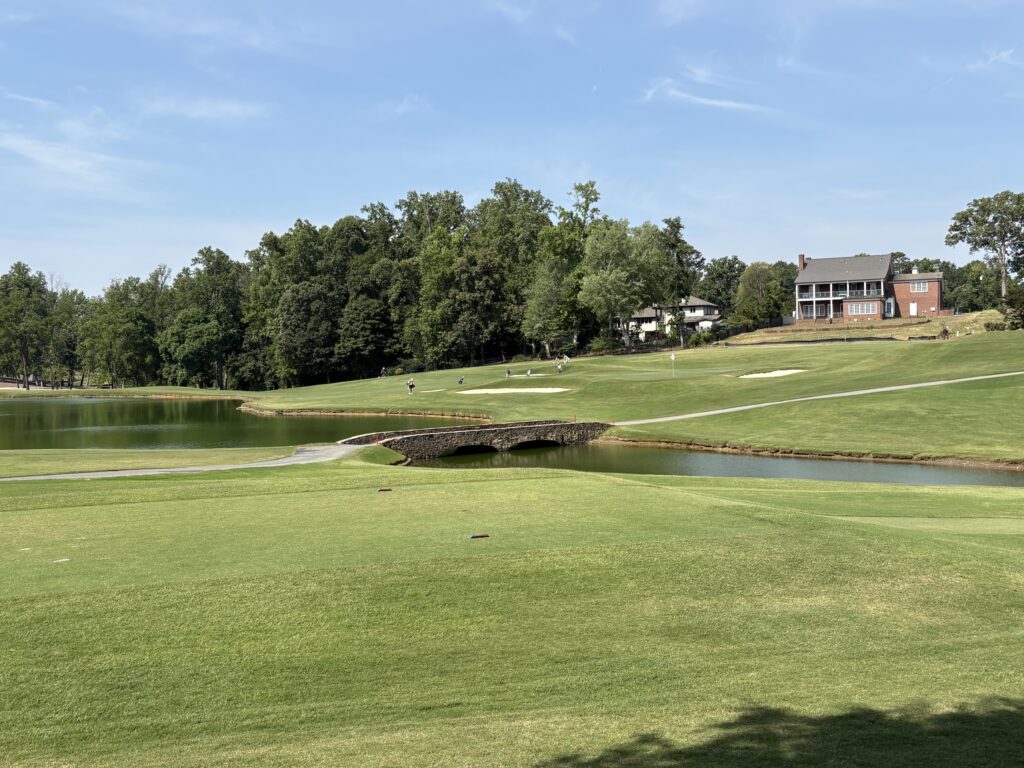
No. 1, a medium-length par-4 is straight-forward. But that’s about it for flat, straight-away holes.
Like Pinehurst No. 2, Sedgefield has the type of lightning-quick, dramatically sloped, elevated, well-bunkered greens expected at top Ross layouts. In fact, though not the turtleback slopes found in Pinehurst, I’ve found the Sedgefield greens to be every bit as difficult.
Approaches and putts can trickle agonizing off greens. Some chips require deft touch to clear banks. Other can be putted.
There are no weak holes. I’ll highlight a few of my favorites:
The interesting routing begins at No. 2, a par-4 featuring a blind tee shot over bunkers and down a hill sloping to the right toward a creek. Bail out left away from the creek and out of bounds and the result is a long shot to a narrow, green sloping toward the extending creek.
Bailing out left and forced to hit a mid-iron approach that found a gaping bunker short and right of the green, I needed two more shots to get on the green.
I bore you with the play by play only because I holed a 30-foot downhill twisting putt that trickled the last four feet sideways into the right side of the cup.
There are plenty of chances to hole memorable putts at Sedgefield.
The par-4 fourth requires an intimidating blind tee shot over tall fescue that needs to draw slightly to set up a clear mid-iron approach.
The par-3 seventh, which can stretch to 215 yards off the back markers and is often into the wind, is a forced carry over a creek that runs just in front of the green and extends along both sides of the putting surface.
No. 12, a par-3, resembles the shorter No. 3, which also features a tee shot over a valley to a hilltop green on the other side. Despite stretching to 225 yards, the hole forces players to stop their shots below the pin on the two-tiered green sloping sharply from back to front to avoid a daunting downhill putt difficult to stop.
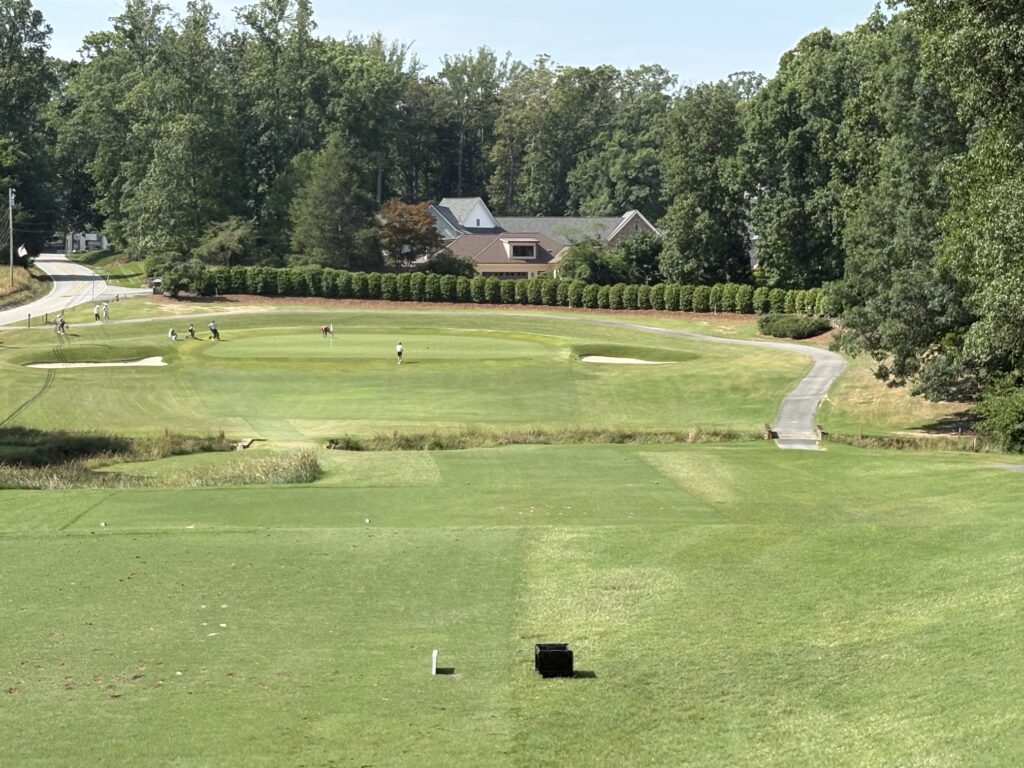
After dumping a poorly struck 4-iron tee shot at 12 into a front right bunker, I managed to come up with perhaps my luckiest shot of the year. From about 100 feet, my low bunker shot climbed the slope, rolled into a few inches of the back fringe and tricked back about 15 feet to within tap-in distance. I didn’t even try to claim I tried to do that.
The par-5 15th may be the signature hole for members. After a solid drive, the second shot is a carry over a lake that cuts into the fairway from the right, making a layup no slam dunk. The hilltop green is one of the most severe on the course.
The approach on the typically windy par-3 16th is over the same lake to a sloping green guarded in the front by two pot bunkers. At 17, a dogleg right, an approach right of the target leaves a testing chip or pitch from a deep depression to the elevated green.
The finishing par-5 – played as a par-4 by the pros – descends sharply down a hill off the tee, leaving a tricky downhill lie for the second shot over a creek into an uphill slope.
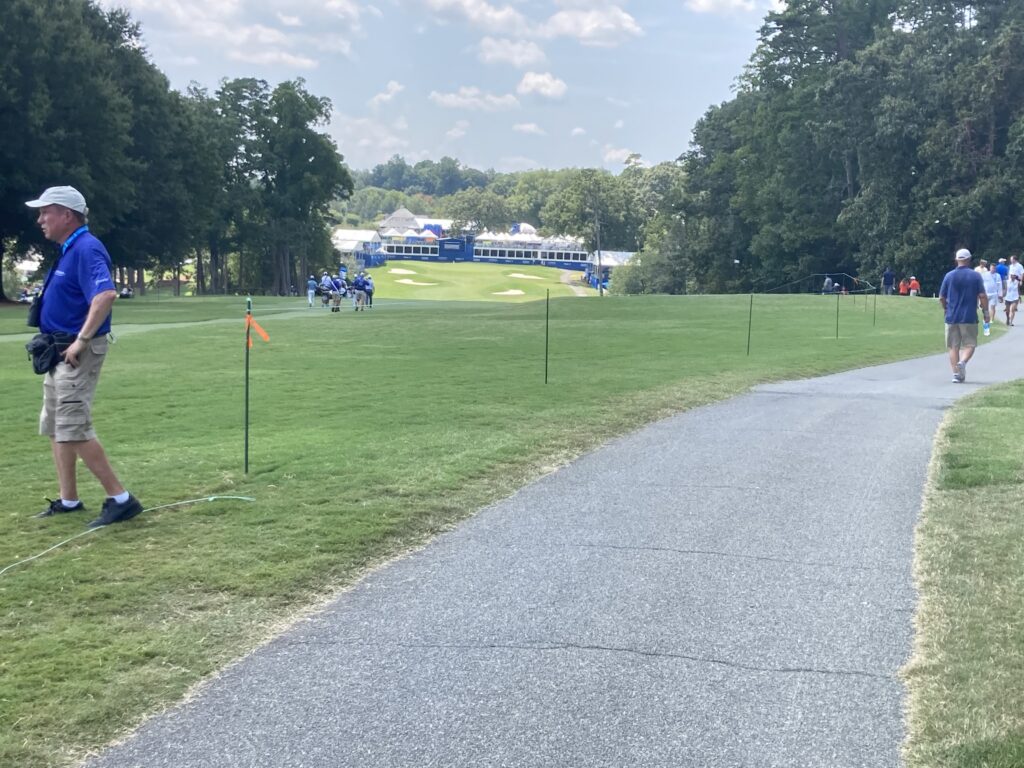
Only the flag – not much of the green — can be seen by players with a wedge up the hill toward the stately Tudor clubhouse in the background. For the members, 18 is a good opportunity for a final par or birdie to tuck away any frustrations from the round.
Sedgefield is difficult – from the tee shots to the approaches to navigating the greens complexes. But there are so many opportunities to make shots not offered anywhere else that you’ll want to come back as soon as possible.