Sunday, May 3, 2026
spot_imgspot_img
Home Blog Page 44

Brennan leads Austin regional; Wake, UNCG move into contention

Sparked by leader Michael Brennan, Wake Forest moved up to sixth place Tuesday in the NCAA Austin Regional at the University of Texas Golf Club.

Brennan shot 3-under-par 68 to grab the individual lead at 7-under 135 as the Demon Deacons pulled within two strokes of Utah for the fifth and final qualifying spot for the NCAA Championship. UNC Greensboro remains in contention, four strokes behind Wake in the 13-team competition.

Wake shot 3-under 281 as a team, an improvement of eight strokes from the first round. Texas holds a 10-stroke lead at 22-under 546 over Tennessee. Notre Dame and Brigham Young round out the top four entering Wednesday’s final round.

Brennan could advance as an individual if he earns medalist honors and Wake does not qualify as a team. Brennan has a one-shot lead over a trio of Texas players. Collin Adams, who shot 70 Tuesday, and Scotty Kennon, who shot 71, are tied for 25th at 143. Marshall Meisel shot 72 after an opening-round 77.

UNCG freshman Kelvin Hernandez is tied for 10th after rounds of 67 and 72. Randall Hudson has posted rounds of 72 and 71. Noah Connor of Reidsville shot 69 for 144, Symon Balbin is at 147 after rounds of 74 and 73.

Rain suspends play Tuesday at Chapel Hill Regional

The third round of the NCAA Regional at Finley Golf Course in Chapel Hill was suspended by rain on Tuesday with the leading teams playing five holes or less.

Host North Carolina did manage to pull within four shots of leader East Tennessee with a 6-under-par start. The Tar Heels are 19-under for the 54-hole tournament. Clemson is in second, one shot ahead of UNC. The teams played almost two full rounds Monday in anticipation of Tuesday’s foul weather.

N.C. State’s Nick Mathews of Mebane, playing as an individual, did not start. Mathews would have a one-stroke lead on the single individual qualifying spot for the NCAA Championship If Georgia Tech and Baylor hold on to the other two team slots. Long Beach and Alabama are within four shots of Baylor.

Mathews did complete the last few holes of his second-round 66 for 7-under 133 early Tuesday morning.

East Surry’s Badgett finishes second at 2A state tournament

Pinecrest, Terry Sanford, Seaforth and Mitchell won titles at the North Carolina State High School Association Championships held at separate courses.

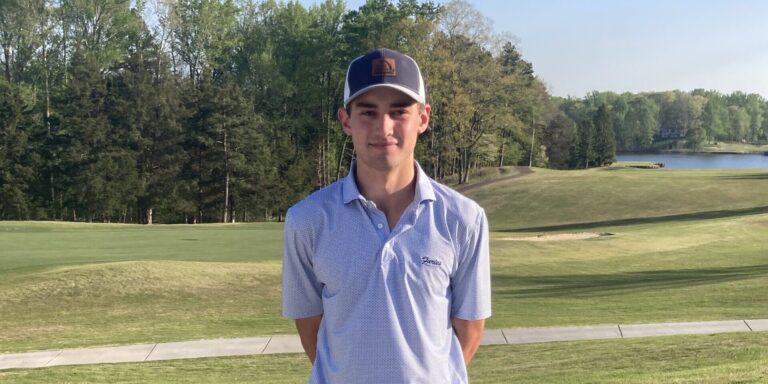
Pennson Badgett of East Surry (pictured) shot 68 Tuesday for a 4-under-par 140 total at Stonebridge Golf Club in Monroe to lead the Cardinals to a fourth-place finish in Class AA, 39 shots behind Pittsboro Seaforth. East Surry shot 19-over 633 for 36 holes. Ty Willoughby of Seaforth was medalist at 135.

In 4A, Carson Bartagnole of Pinecrest was medalist with consecutive rounds of 68, including a hole-in-one Monday at Pinehurst No. 9. The Southern Pines team finished at 14-under 562, 14 strokes ahead of second-place New Hanover. Northern Guilford finished eighth and Grimsley placed 12th.

In 3A, Terry Sanford of Fayetteville finished at 9-under 567 at Longleaf Club in Pinehurst to beat Rose by 14. Oak Grove placed fourth at 610 and Southern Alamance shot 642 for 10th. Rich Wills of Belmont Cramer was medalist at 8-under 136.

In 1A, Bakersville Mitchell shot 474 to beat Mount Airy by three strokes in a tournament shortened to 27 holes due to Tuesday’s rain at 7 Lakes. Connor Warren of Mitchell was medalist with 1-over 107. Hiatt Shockley of Mount Airy tied for third at 112. Bishop McGuinness finished sixth as a team.

Fuller wins N.C. Senior Amateur at Holly Ridge

Dale Fuller of Raleigh shot 3-under-par 69 Thursday at Holly Ridge Golf Links to hold off Daniel Neveu of Pinehurst by three strokes and win the Carolinas Golf Association N.C. Senior Amateur Championship.

Fuller claimed his first CGA title at 7-under 209. Perennial contender Paul Simson of Raleigh tied for third with Tee Burton of Shelby and Jonathan Sielsky of Huntersville at 213.

Fuller’s was sharp from the start in the final round, making birdies on holes 2, 4, and 7. He shot even-par 36 on the back nine for the comfortable victory.

“I drove it really well. I was just really solid tee to green, and was able to make a few putts,” said Fuller, who has been in contention in several CGA events. “This is my first CGA win so it feels great. It’s been a long time coming; I thought I should’ve already had one, but I’m very proud to be the champion here for sure.”

Greensboro’s Marc Cox, a longtime member at Holly Ridge, entered the day tied for the lead with Fuller. Cox had shot 68 Tuesday to lead after the opening round.

Hindered by a triple-bogey at No. 12, Cox closed with 75 and finished in a tie for sixth at 1-under. With bogeys on the final two holes, he shot 39 on the back nine. Cox also had a triple-bogey on the fourth hole in the second round.

Kuehn, Pate lead Wake to third in Bermuda Run Regional

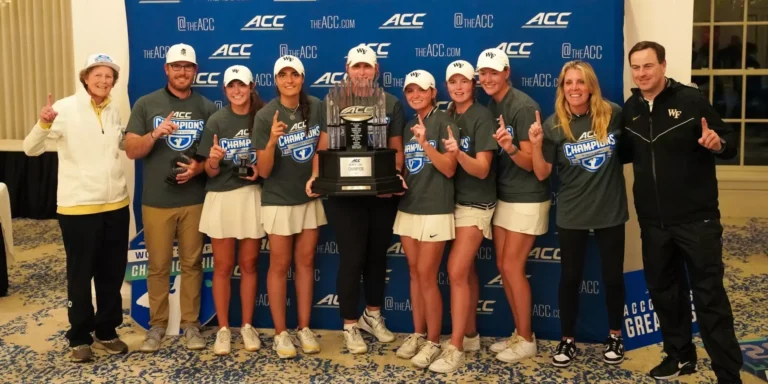
Rachel Kuehn tied for medalist honors at 12-under-par 204 to lead Wake Forest to a third-place finish behind Ole Miss and Texas on Wednesday at the women’s NCAA Regional at Bermuda Run’s East Course.

Kuehn shot 69 in the final round, but was caught by Ole Miss’ Caitlyn Macnab, who closed with 67 in the same group, including a bogey-free run of six birdies on the final 13 holes. Texas played the final four holes in 1-under.

Powered by Macnab, Ole Miss finished at 21-under 843 in the 54-hole regional, one ahead of Texas and three ahead of Wake, which led most of the day. Wake’s five-player lineup played the last four holes in 6-over. Ole Miss shot 3-under and Texas was 1-under over the same stretch.

Macy Pate, a Winston-Salem resident, shot a steady 71 tied for seventh at 6-under. The freshman was the only Wake player to match par over the final four holes. Pate’s highlight was an eagle on the 378-yard par-4 11th hole. Kuehn eagled the 538-yard sixth.

Mississippi State finished fourth. Oregon State was fifth. The top five teams qualified for the NCAA Championship at Omni La Costa Resort on May 17-22.

Mathews falls short of qualifying; UNC advances

Emily Mathews of Virginia Tech, a Mebane resident, fell just short of qualifying for the upcoming NCAA women’s championship Wednesday at the Cle Elum, Washington, regional.

Mathews shot 76 to finish the 54-hole tournament at 5-over-par 221 in a tie for 14th place. Though Tech did not advance as a team, Mathews was in position to change for the regional’s one individual qualifying spot for a player not on a qualifying team.

Mathews bogeyed her 16th and 17th holes to fall three strokes from entering a playoff. Teammate Morgan Ketchum of Winston-Salem shot 73 for a 225 total, second-best for the Hokies. Stanford won by 18 strokes, followed by Duke and Virginia.

Stanford players finished first, second, third and fifth on the way to a 17-under score. Emma McMyler of Duke was sixth at 215.

At 21-over, North Carolina placed third at the Auburn Regional to advance. UNC finished 11 behind Auburn and seven from Oregon. Kayla Smith of UNC tied for fifth at 215. Megan Streicher shot 217.

Pate in fifth as Wake leads at Bermuda Run regional

Rachel Kuehn and Macy Pate remained high on the individual leaderboard for first-place Wake Forest after two rounds of the NCAA women’s golf regional at Bermuda Run East.

Meanwhile, Mebane native Emily Mathews is tied for 12th after rounds of 72 and 73 3at the regional at Tumble Creek Club in Cle Elum, Washington, despite a disappointing finish to her second round. Morgan Ketchum, who played with Pate at Reagan High, shot rounds .     The Hokies are in ,      from the fourth qualifying spot.

Wake’s 558, 18-under-par total at Bermuda Run leads Texas and Ole Miss by six strokes. Mississippi State is fourth, 13 behind. Kuehn has shot rounds of 67 and 68 and trails Bailey Davis, who shot an opening-round 64, by one stroke. Pate shot rounds of 69 and 70, and is tied for fifth.

Stanford has a commanding 12-stroke lead over Duke in Washington, with Virginia and Arizona State for the other qualifying spots. Tennessee trails MSU by one stroke and North Texas by three with one round left.

The top four teams after Wednesday’s final rounds of the six regionals advance to the NCAA Championship. Tennessee trails MSU by one stroke and North Texas by three in the race to grab the final qualifying slot.

North Carolina is in third at the competitive Auburn, Alabama, regional, behind Auburn and Houston. Only seven strokes separates second place from seventh at Auburn University Club entering the final day.

High Country offers high-profile public options

Granted, when you think N.C. High Country golf courses, the first that come to mind for many golfers are the spectacular clubs that make national top 100 course lists.

And the list of public options continues to shrink.

Linville Golf Club, for decades the elite choice open to guests of the historic Eseeola Lodge, went entirely private during Covid-19 and decided to stay that way. More recently, Beech Mountain, a longtime option for resort guests, did the same.

They joined a list topped by exclusive Avery County neighbors Diamond Creek, Elk River and Linville Ridge; Blowing Rock in Watauga County; and Roaring Gap and High Meadows in Wilkes County. Jefferson Landing in Ashe County and Hound Ears in Watauga allow some resort play.

Still, visitors to Watauga, Avery, Ashe and Wilkes counties have a solid group of options offering outstanding mountain golf at prices slightly higher than typical in the Triad, but more affordable than destinations such as Pinehurst and the South Carolina coast, especially during their respective high seasons.

Boone Golf Club and Mountain Glen in Newland are premier layouts from well-known architects with well-manicured conditions, each under $100 on weekends, and lower on weekdays. Mountain Aire, Ashe’s premier public course, includes the par-4 third featuring perhaps the most memorable downhill tee shot in the region.

Here’s a look at some of top options:

BOONE GOLF CLUB

With a location in the region’s biggest city with a college population of more than 20,000, it’s no surprise that Boone Golf Club is a hub of activity, generating about 35,000 rounds during a typical 6-month season.

The Ellis Maples design (pictured) built in a valley filled streams and only a few neighboring homes on the south edge of Boone, is a challenging par-71 layout stretching to almost than 6,700 yards and requiring a variety of shots.

The distance between greens and tees is modest. Many of the regulars walk the course. Only a few holes, Nos. 9 through 11, require significant uphill walking. The fairways are deep green and lush. A few fairway bunkers were remodeled early this year.

“It’ll be one of the best-conditioned public golf courses you’ll play anywhere,” said assistant pro Art Adams.

Putting skills are put to the test on the course’s large, slick bent grass greens. The combination of speed and undulations make three-putting a consistent concern, especially from above the hole. Fairways are bordered by trees, high grass, streams and high grasses.

The huge, three-tiered putting surface on the par-5 sixth hole can easily turn a birdie putt into an eventually double-bogey. The putting test comes after a tight tee shot to dogleg, followed by either a long carry over a lake to the green perched just below the hilltop clubhouse, or a short iron third shot over the water.

The most memorable tee shot comes on No. 10, where the drive comes out of a tight chute of trees to land on a hillside sloping dramatically to the fairway on the left. The hillside remains in play on the second shot with the third shot to perhaps the course’s smallest green cut into the hillside, making an errant approach to the left tumble several down a steep slope.

The par-3s at Boone are difficult. Nos. 3, 8 and 16 stretch to more than 200 yards with surrounding water and wetlands. Distance is tough to judge on No. 11, where the tee shot carries over a drop-off to a green atop a hillside obscuring much of the putting surface.

Boone opened in mid-April at $75 on weekdays and $80 on weekends, cart included, and prices will rise as the greens increase in speed as visitors arrive in force in May and June.

MOUNTAIN GLEN

A little farther off the beaten path is Mountain Glen, another walkable valley layout only a few miles from the Tennessee line. The George Cobb design has rolling terrain, though unlike many mountain courses, there are few if any blind shots and putting surfaces can be seen from the fairways.

The first three holes can be seen from N.C. 194, between Newland and Elk Park in the Cranberry area. The par-72 course stretches to 6,528 yards.

“It’s not necessarily your typical mountain golf course,’ said pro Robert Novak, new to the course this spring after the departure of longtime pro and assistant David Burleson, the son of N.C. State basketball legend Tom Burleson. “Everything is pretty much in front of you.”

Like Boone, Mountain Glen has a reputation for well-manicured tees, greens and fairways. Mountain Glen opened at $65 for greens fees and cart on weekdays and $70 on weekends. The price will increase to $83 on weekends later in the season.

“We are delivering a premium experience,” said Novak. “At that price, it’s a great value.”

Mountain Glen’s front nine is relatively open with small bent greens and flat fairways. The signature hole is No. 11, an uphill dogleg left. The finishing holes wind down to the clubhouse.

MOUNTAIN AIRE

The terrain at Mountain Aire is hillier than Boone and Mountain Glen. The West Jefferson layout is well-maintained with fast undulating greens. The routing on the 6,415-yard pare-72 course is solid, though not quite as polished.

With dramatic elevation changes and rolling fairways, Mountain Aire has a true mountain layout feel. The prices are hard to beat, starting at $45 on weekdays and $50 on weekends this spring.

Errant tee shots can roll down hills far off the fairway, leaving difficult recoveries.

At No. 3, a 468-yard par-4 from the back tee, players drive over a 200-foot drop-off to a tiny landing area bordered to the right by grassy backstop hill. To the left, is another dramatic dropoff that could be used in a Ben Stiller AT&T commercial. Go left, good luck finding your ball. More luck is needed to get it back in play and make a single-digit score.

At the short par-4 No. 9, players lay up down another steep downslope in front of a pond that guards a small green. The course includes a few other short par-4s. Only one of four of the par-5 reaches 500 yards, but they are uphill.

OTHER OPTIONS

SUGAR MOUNTAIN

It’s tough to find a better short-game test than Sugar Mountain, which turns 50 this year. The par-64 municipal course has tricky, smooth bent greens that make a strong defense of par. Stopping a downhill putt close to the hole can be almost impossible.

Frank Duane, once Arnold Palmer’s top designer, was the architect.

With mature trees, flowers near tee boxes and other landscaping extras, Sugar Mountain has an almost park-like feel with scenic elevation changes.

The longest par-4 is 353 yards, but several approaches require deft touch to avoid water and woods. The only par-5 is 390 yards, but winds up a steep hill bordered by creeks and woods.

Though the 4,371 yards on the scorecard may make the course look easy, the elevation changes and the undulating, fast greens make it extremely challenging.

OLDE BEAU

In the Wilkes mountains, the choice is Olde Beau, a hilly 6,500-yard, par-72 course with spectacular views in Roaring Gap. Many of the greens are protected by water. In recent years, renovations have eliminated some blind shots that frustrated visitors.

The course has par-3 tees on every hole on the front nine, making it attractive to small children and beginners.

The 18-hole price for greens fees and cart opened this spring at $59 on weekdays and $79 on weekends.

LINVILLE LAND HARBOR

Linville Land Harbor’s front nine is about 3,000 yards and has a solid reputation. The back nine is polarizing. Tom Jackson designed nine holes. Later on, the membership of the communitybwanted another nine. As a result another was shoehorned into the available property. As a result, several short doglegs were created on the home nine, taking woods out of the bag.

The result was a 4,877-yard par-69 layout concluding with a 196-yard par-4, where players are asked not to drive the dogleg for safety reasons.

The price for greens fee and cart was $56.42 early this spring. The course is generally in good condition.


Forsyth Country Day standout Howe cites future prospects in choosing Yale

Though a pro golf career remains a dream for Preston Howe, the Forsyth Country Day School junior made academics the priority when deciding to play college golf in the Ivy League.

In March, Howe committed to Yale University, one of the nation’s most prestigious academic institutions, known more for producing U.S. presidents than PGA Tour players.

Why Yale? Howe doesn’t have friends or family near New Haven, Connecticut, nor any family ties to the Ivy League School.

“Academics kind of drew me there,” said Howe, the top-ranked player in the N.C. Independent Schools Athletic Association Division II rankings. “I had some other schools with bigger golf programs interested in me. I decided I’d rather have my future set up with a Yale degree.”

By choosing Yale, Howe will have to battle cold weather practicing in Connecticut much of the fall and spring seasons. But the Yale Golf Course, currently undergoing some renovations, is not only one of the most historic college courses, but is widely considered one of the best.

Designed in 1926 by Charles Blair Mcdonald and Seth Rayner, the course was ranked No. 83 in the world by Golf Magazine and rated the nation’s best college course by Golfweek.

“By the time I get there, it should be finished,” the 17-year-old Howe said. “It’s going to be nice.”

Plus, Yale travels to warmer climates for most of their tournaments. This past season, the Bulldogs played in tournaments in Mexico, Houston and San Diego during the late fall and winter.

“I get to go on a lot of cool trips there,” he said.

An outstanding student whose favorite subject is math, Howe said he also considered Stanford and Wake Forest, where friend and former FCS teammate Kyle Haas joined father Jerry Haas’ team this year. The Howe family are members at Old Town Club, Wake’s home course.

“Computer science and engineering have always been interesting to me,” said Howe, who joked that his experience this year in calculus may lead to a change of heart.

Stanford, an elite institution where the likes of Tiger Woods and Tom Watson have played, was Howe’s top choice. But the Palo Alto, California, school didn’t offer him a golf scholarship. As an Ivy League school, Yale doesn’t offer athletic scholarships, but offers significant financial assistance to most students.

“I really wanted to go to Stanford,” Howe admitted. “Stanford would have been the best combo.”

Knowing how competitive Ivy League admission is, Howe said he initially contacted Yale, coached by Keith Tyburski, a former Western Carolina University golfer. Tyburski offered Howe a spot in December.

Howe already has one friend of the Yale roster. Blake Brantley, a former standout at R.J. Reynolds High, will be a senior next year.

Howe works with instructor Chase Duncan, whose client Ashkay Bhatia won the PGA Tour event prior to the Masters, at N.C. State’s Lonnie Poole Golf Course every 4-6 weeks.

Howe, who has three top 10 finishes in nine American Junior Golf Association events in the past 12 months, tied for eighth in March at the Will Lowery Junior Championship, his only AJGA start so far in 2024, at Carolina Trace in Sanford.

Duncan said Howe’s retention of his lessons quickly caught his attention, noting at age 12 Howe’s written summaries of lessons requested by Duncan, were amazingly comprehensive and thorough.

Howe had an exciting week in early March, shooting 4-under-par 32 for FCDS in a 9-hole match at Greensboro National Golf Club, then winning the North State Boys’ Challenge the next day with a bogey-free (his first in competition), 4-under 67 at Country Club of Salisbury, after announcing his commitment to attend Yale.

Duncan said the public commitment to Yale may rid him of some self-inflicted pressure, helping him complete the bogey-free round, a failure that had caused frustration.

“I think that’s (the bogey-free round) a testament to putting the decision behind him,” Duncan said. “I told him the decision (to play lower-profile college golf) might ‘free you up to play better golf.’”

As the high school season winds down, FCDS was No. 2 in the Division II team rankings, behind Cape Fear. Greensboro Country Day School, which beat FCDS by one stroke to win a state title last year, is ranked No. 3.

Though Howe carries only 145 pounds on a thin 6-foot frame, he still manages to carry the ball 290 off the tee, and uses his 3-wood as one of his top weapons.

While Yale should ensure a successful financial future with various options, Howe said he hasn’t ruled out trying to play professional golf.

“It’s still on the table,” he said. “I’m going to pursue it as long as I can.”

Duncan said Howe has no major weaknesses in his game with potential to play at a high professional level.

“I think he just needs to keep building confidence and prove it to himself,” Duncan said

Mathews’ small stature can’t obscure powerful game

Despite her trim, 5-3 stature, Mebane native Emily Mathews generates prodigious power with her golf swing, driving the ball at least 275 yards, according to her coach.

Chase Duncan, the longtime instructor at Lonnie Poole Golf Course in Raleigh whose pupils include PGA Tour winner Ashkay Bhatia, jokes that the petite Mathews, a standout freshman at Virginia Tech, swings a golf club like a man and shows remarkable toughness. Duncan says she generates more clubhead speed than the average LPGA Tour player.

“She’s 5-3, 115 pounds and swings it like a grown ass man,” said Duncan, who has worked with Mathews for about six years. “She swings it beautifully. She rotates really well. She gets a lot of strength from her lower body.”

Megan native Emily Mathews of Virginia Tech generates big-game power from her petite frame.

Maybe Mathews developed her power-generating swing by watching her brother, Nick, a redshirt junior on the N.C. State golf team. They grew up playing at Mill Creek Golf Club.

Mathews said the surprising power is the result of setting up in a “squat” position and generating power by pushing off the ground while not sacrificing accuracy.

“With my legs, I get a lot of speed through impact,” she said.

Mathews quick success at Tech — her 73.17 stroke average was No. 2 on the team behind Winston-Salem native Morgan Ketchum entering the ACC Tournament in late April at Porter’s Neck in Wilmington — is no surprise.

Matthews was one of the nation’s top juniors. She won the N.C. Class 3A state title for Eastern Alamance High in 2020, 2021 and 2022, earned invitations to several elite American Junior Golf Association events and qualified for two U.S. Junior Girls’ Amateurs, advancing the match play in 2022. Her success led to an equipment deal with Mizuno.

She had many offers, including full-ride options at UNC and N.C. State, but felt most wanted at Tech, which also gave her the opportunity to live outside the Raleigh area.

“They (Hokies coaches) treated me like I was their No. 1 priority,” Mathews said. “They felt that I had the potential to be a great player.”

Majoring in sports media analytics, Mathews applies those skills in her golf game. She closely watches top players, especially those she’s paired with. After each round, she sits down and writes “reflections.” Her game also reflects her other focus of studies at Tech — organizational leadership,

Those could include anything from shot preparation to set-up, shot selection and execution.

“I’m super-attentive,” Mathews said. “I watch (other players) and try to pick their brains. In 18 holes, I try to learn at least one thing. I learn one thing from one person and learn one thing from another. “I’m probably the only one on the team who does that. I think in the end, it will benefit you.”

Though she’s played well from the start at Tech, Mathews first semester was a struggle as she batted the effects of bronchitis.

“I was pretty much sick the whole semester,” Mathews said. “But I had endless support. I kept working, and I was in a good place with my swing. I’m not exactly sure how I did it.”

Mathews finished in the top 20 in the Wolfpack’s four fall tournaments, shooting 67 in rounds at Oklahoma’s Schooner Classic and the Landfall Tradition near Wilmington, where she finished 13th.

For the year, she leads the Hokies with a 72.75 stroke average in the final round of the team’s eight stroke-play tourneys.

Mathews got off to a slow start this spring. But her best finish, a tie for 38th at the Clemson Invitational, came in Tech’s last stroke-play event prior to the ACC Tournament. In April, she beat Wake Forest’s No. 1 player Carolina Chacarra, who carried a sub-70 stroke average and was in the top 15 in the national rankings.

The 1-up victory over Chacarra helped the Hokies finish second in the Wolfpack Match Play at Lonnie Poole.

Like most top college women’s players, Mathews aspires to play on the LPGA Tour.

“That’s my childhood dream,” she said. “I’m trying to do everything to put myself in that position.”

Regardless, she plans to find a career involving the sport.

“Hopefully, it will be something related to golf,” Mathews said. “I’m in love with he sport and would live to use my degree in that way.”