


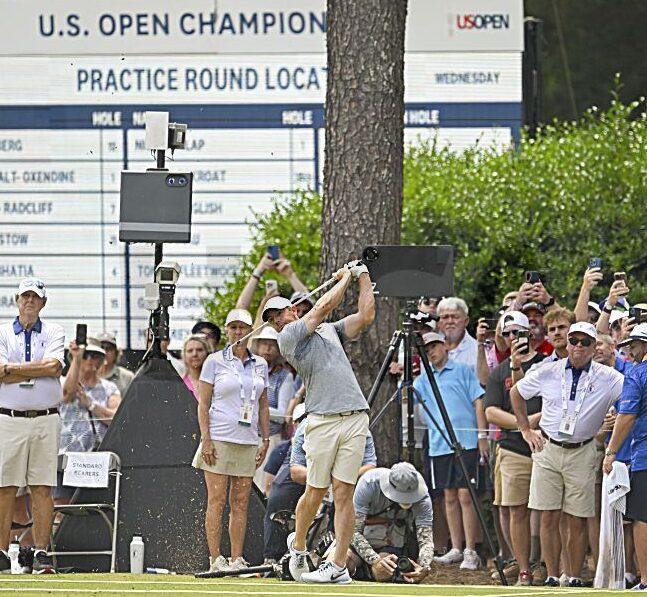
The world’s No. 1 player, Scottie Scheffler, isn’t there.
If you bought tickets to this weekend’s Truist Championship, knowing it was a “Signature Event” and believing the world’s top player would be at Quail Hollow, you’re wrong.
Let the righteous brothers on the PGA Tour continue to vilify former colleagues who accepted guaranteed millions to take it easy and join LIV. Those LIV players were deemed greedy traitors who didn’t appreciate what the PGA Tour did for them.
But those same Tour players who forced the creation of “Signature Events” with limited fields and $20-million guaranteed purses as compensation for forgoing LIV opportunities, haven’t lived up to their end of the bargain.
Witness the absence of Scheffler at Quail Hollow this weekend.
In return for the Signature paydays, the world’s best were required to play. In fact, missing two in a row was to trigger a $3-million (player impact) fine, which No. 2 Rory McIlroy supposedly paid in 2023, to skip the RBC Heritage at Harbour Town.
The PGA Tour has confirmed there are no more automatic fines for missing Signature Events.
Designed to protect sponsors putting up the big money, to keep PGA Tour stars onboard, is no longer important to the players. Bottom line, the Tour isn’t going to war with its stars. LIV, which had been offering hundreds of millions for them to jump, is sinking.
Now, with Brooks Koepka (does anybody care about Patrick Reed?) back in the fold, and Bryson DeChambeau, Jon Rahm and Cameron Smith expected to come begging back soon, supporting the sponsors doesn’t seem to be so important.
Quail Hollow will be a return for McIlroy, a no-show at the previous two Signature Events at Harbour Town and Doral after winning his first Masters title.
Scheffler is taking a break from the road and preparing for next week’s PGA Championship at Aronimink, a classic Donald Ross course out of the major rotation since 1962.
No knock on Scheffler. He’s played nine events his year. He’s done more than his part for the Tour, though title sponsor Truist and advance ticket holders have a right to complain.
As Grand Slam winner McIlroy has argued, playing a limited schedule follows the pattern of Tiger Woods and Jack Nicklaus, who focused on preparation for major championships.
It seems clear that the PGA Tour panicked when LIV plucked a few of its stars.
When the Tour forced sponsors to hike their contributions to Signature purses — the Truist purse was doubled — for eight (now nine) Signature Events, the sponsors probably believed all the best players would show up.
And it all might have worked — if the Tour had properly distributed its big-money events throughout the schedule. But they didn’t do it. Prior to Quail Hollow, Scheffler played three events in four weeks.
The whole Signature Event format doesn’t work. It created a tier system among players, long honored as equally treated individual contractors. It led to goofy rankings (Aon 5, Aon 10) to make sure the hottest low-tier players can gain a berth in Signature tournaments.
In non-Signature PGA Tour events, fields can have 144 players (down this year from 156). Because only 70-80 can play in Signature events, the rank and file is left to battle for purses such as the $4 million offered this weekend at The Dunes Golf and Beach Club in Myrtle Beach.
There have to be changes soon. PGA Tour stars have no incentive to play in any non-Signature, smaller-purse events. We’re used to that with the Wyndham Classic, where the fight for the last spots in the FedEx Cup has become the storyline.
But the Signature events have created a tour with 13 events, including the four majors, for the stars. Throw in the Players Championship and the Scottish Open, a typical preparation for the British Open, and you’ve got 15 events — the minimum PGA Tour members are required to play. That’s doesn’t include the three FedEx Cup tournaments, for players who qualify.
Before the Signature series, the participation of the game’s stars were scattered somewhat throughout the yearly schedules — intentionally. In 2016, the PGA Tour forced players to play in one tournament where they had never played. If that policy had been continued, we may have seen Scheffler and McIlroy at Sedgefield in recent years.
Signature events have been divisive. The PGA Tour created two tiers. To get the game’s elite, sponsors had to pay for a Signature event. The value of nine events was enhanced at the expense of 21 others.
LIV created a second tour. Then, the PGA Tour split between halves and have-nots. With LIV on its deathbed, it’s time for the PGA Tour to come back together — for the game, the fans, the sponsors and the majority of the players.

