
By John Brasier
A Triangle club with a century-old Donald Ross design — tweaked a handful of times over the decades — plans to make renovations to restore the original “magic” of the historic layout.
Greensboro-based architect Kris Spence, considered a master at restorations and renovations of Ross designs, will begin an extensive project in January on the Hope Valley Country Club course, which is expected to reopen in mid-to-late fall 2027.
“We’re pretty much touching the whole canvas,” said Spence, whose renovations at several prominent Ross designs have been highly acclaimed.

Hope Valley features undulating fairways, often lined by mature trees.
The project will include rebuilding the greens, which have risen higher above the fairways over the years, to their original height with increased contours.
The goal is for the new TifEagle Bermuda surfaces to play much as they did in the original 1926 design. Spence is using a full set of Ross’ original drawings as a guide. The collars will be Tahoma 31 Bermuda, known for its resilience to various weather conditions.
Over the years, architects Perry Maxwell, Dan Maples, John LaFoy and Brian Silva, who made the last changes in 2003, have updated the course.
Rolling over heavily wooded hills in a historic, affluent residential area in southwest Durham, the par-70 layout stretches to 6,720 yards, from where it plays to a 72.9 rating and 136 slope.
“We’re really trying to restore this to a true Donald Ross course,” said Hope Valley general manager Aaron James, who was appointed in May by management company Bobby Jones Links.
“The greens will have some nice ridges and spines with folds and twist and turns,” Spence said. “We can capture the features in a manner that we can reclaim hole locations and corners. They’re going to have enough bite to them if in the wrong position you’re going to feel Donald Ross.”

The new greens will feature more undulation than the current Champion Bermuda surfaces.
Spence also plans to bring back a variety of Ross bunkers, including some cross bunkers in the fairways. The bunker count will increase from 55 to 59. A few will be moved to better fit the strategy and topography.
The fairways will be sodded in Zeon Zoysia, a grass with strong resilience to cold that has performed well at Country Club of North Carolina.
Spence, who renovated Hope Valley’s practice area last year, has already removed many trees. The project also includes significant irrigation and drainage work.
But on Ross designs, the focus is typically on the greens complexes. And Spence’s work at Hope Valley will be no different.
Spence said he believes previous renovations veered from Ross’ intentions. One renovation added dramatic undulations. The latest, about 25 years ago, took the opposite approach, leaving flatter greens with higher edges – atypical of Ross creations.
“The last renovation really didn’t capture the beauty of those Ross greens,” Spence said. “When I saw Ross’ drawings, the beautiful contours were missing. The magic of these greens was missing all over the course. I intend to bring back an authentic example of Ross’ work.”
Perhaps the most notable change in the fairways will be the restoration of a creek winding diagonally across the right side of the fairway that was filled in at No. 11, a hole called one of the greatest in the world by Ben Hogan, who later commented that eliminating the creek “ruined” the hole.

The new bunkers will be built with capillary concrete and G-Angle sand to provide better drainage.
James said improvements, including clubhouse renovations and a rebuilt tennis shop, in the past few years, have generated enthusiasm and energy among the membership. The club will celebrate with fireworks at a New Year’s Eve party. Groundbreaking on the course changes will follow on New Year’s Day. A black-tie celebration is scheduled for Jan. 9.
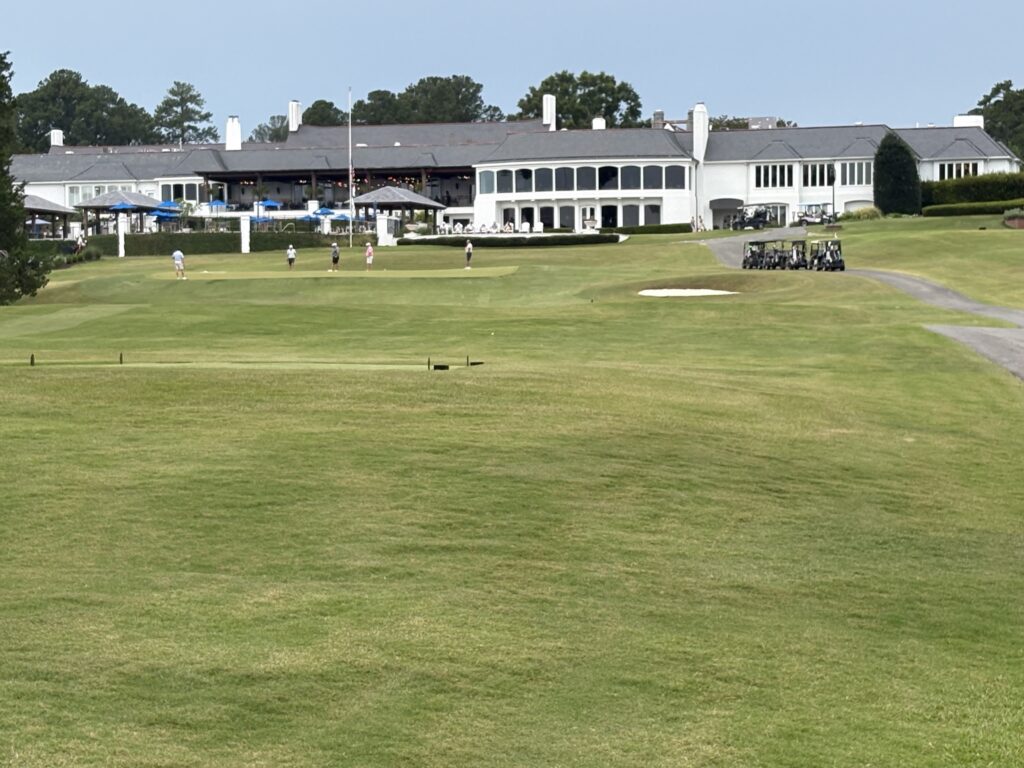
Hope Valley has an active membership. In mild weather, the patio behind the 18th green (shown in the top photo) on the difficult, uphill par-3 finishing hole is a popular gathering area. The course has played host to 28,000 annual rounds.
“The club is booming,” James said. “The membership is very excited.”
Though lauded for his work on several high-profile Ross designs, including Sedgefield and Roaring Gap, and Holston Hills in Knoxville, Tennessee, Spence’s recent creation of the Quixote Club layout in Sumter, South Carolina, and his reclamation of Woodlake in Vass — both courses currently ranked among the best in their states by national magazines — have earned high praise and raised his profile.
At Hope Valley, Spence sees a great opportunity to make an outstanding course special.
“It’s a very unique golf course,” he said. “It has some dramatic topography. Hope Valley asked us to bring it back and create something authentic.”