
I give credit to the USGA and the Royal & Ancient for making some common-sense rules changes over the past few years.
Many of us who play solo rounds especially enjoy the option of leaving in the pin while holing putts. Most golfers are happy they can now fix ball and spike marks in the path of their putts.
But I wouldn’t blame Paul Mitzel for arguing that that golf’s ruling authorities still have a ways to go in making more changes — at least in penalty assessment.
For instance, why do you get a free drop for your stance on a cart path after a wayward drive, but have to play a ball in divot as it lies in the middle of the fairway?
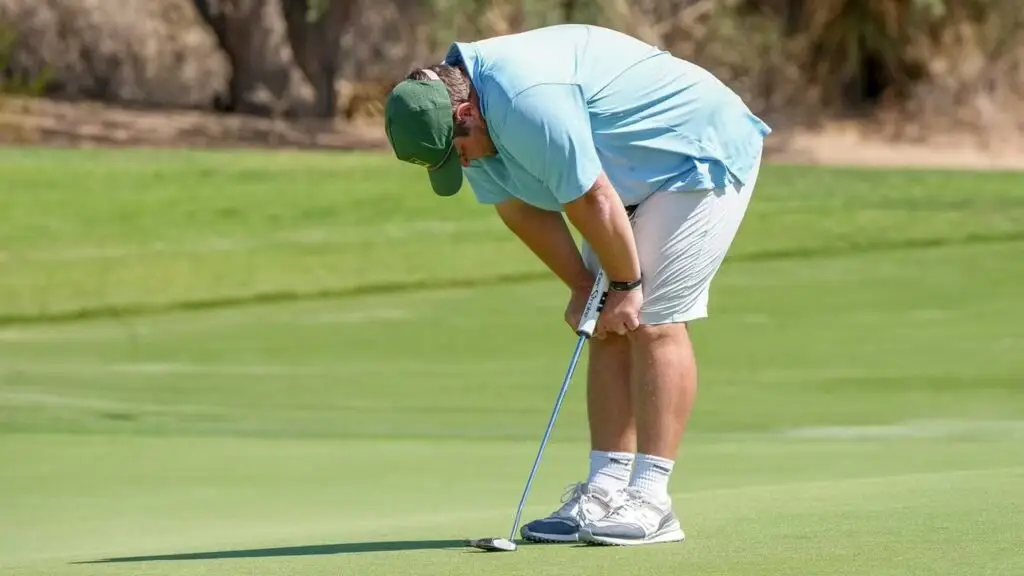
If you didn’t already know, Mitzel lost his first-round match in the U.S. Mid-Amateur at Troon Country Club in Scottsdale, Arizona, on Monday because his caddie accepted a ride to the tee of the second playoff hole from a volunteer, who apparently asked the caddie if he wanted a ride.
A USGA referee walking with the pairing noticed the infraction. Result: loss of hole, loss of match. Mitzel, a 35-year-old from Seattle, was out. His opponent, Ryan O’Rear of Georgetown, Texas, asked the USGA if he could refuse the penalty. He didn’t want to win that way.
But the USGA said no, citing Model Local Rule G-6 that states: “During a round, a player or caddie must not ride on any form of motorized transportation except as authorized or later approved by the Committee. … If the breach occurs between the play of two holes, it applies to the next hole.”
Longtime Carolinas Golf Association executive director Jack Nance, who retired this year, told TriadGolf.com that the ruling was “unfortunate,” but the referee had no choice but to make the call.
“Had there not been a referee with the match, the opponent could have overlooked it,” Nance told TriadGolf.com.
I don’t know many golfers who wouldn’t find G-6 to be draconian in this case.
Mitzel didn’t benefit. His caddie did. — a little. I can’t think of how Mitzel unfairly benefitted. Did the ride help the caddie help his player? I doubt it.
Then, there’s at least two special circumstances.
First, how would the caddie (a friend of Mitzel, not a professional looper) know he couldn’t accept a ride — especially an offer from a tournament volunteer?
Second, the same volunteer had just transported the players from the 18th green to No. 1 tee for the first playoff hole. So, why would the caddie refuse a ride up the hill?
Golf has a Rule of Equity for circumstances not covered in the Rules of Golf. Unfortunately, G-6 was in effect.
As a result, three people have to suffer and another has an unearned victory.
Mitzel will never know how far he might have advanced in the Mid-Am. At 35, in an event dominated by players closer to 25, this might have been his last chance.
The caddie has to live with costing his friend a chance to advance in a national championship.
The unnamed volunteer has to live with making a mistake that knocked Mitzel out of the tournament.
And O’Rear has a victory colored by the manner in which it was attained.
Nobody really won. I understand the reason for the rule. But since a player wasn’t involve, why not give a warning instead of letting the infraction decide the match?
Now, about the fairness of hitting from a divot in the middle of the fairway …