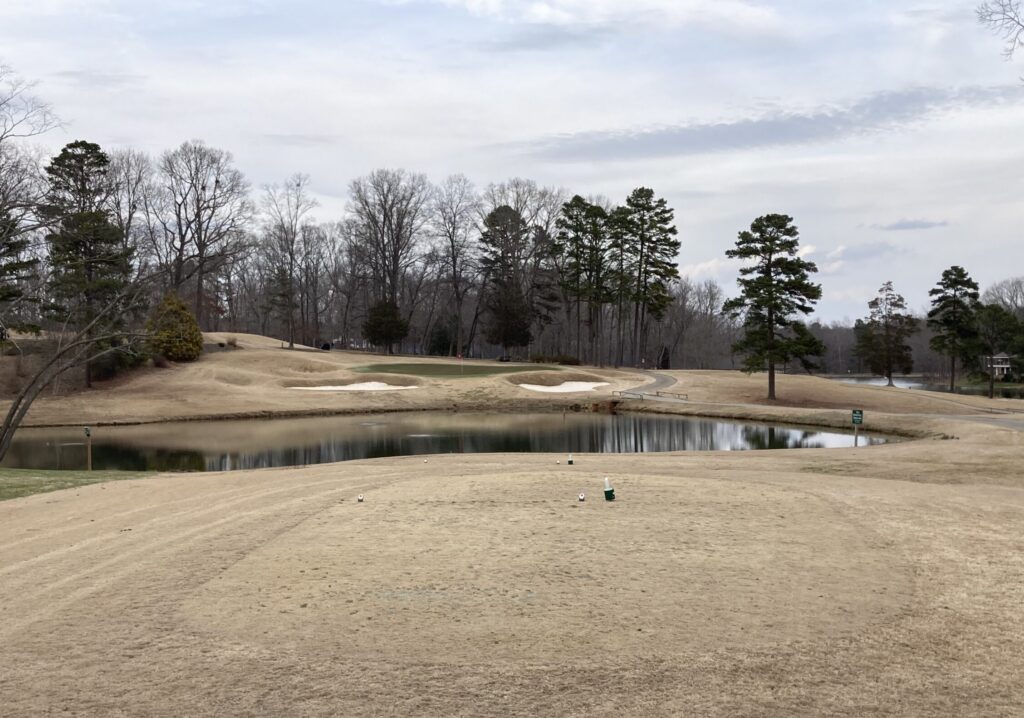
When he arrived at Hound Ears Club only a few days after Hurricane Helene flooding wreaked havoc on the High Country, Kris Spence was astonished at what he saw.
Just getting to the club was difficult. Roads and bridges were demolished. Trees and homes were leveled. Power lines were down. Debris was everywhere. Many residents were trapped in their homes.
The club, located along the Watauga River in a valley surrounded by peaks, looked nothing like the posh summer retreat built 60 years ago with its Bavarian-style clubhouse and meticulously manicured golf course.
“It was just utter devastation,” the Greensboro-based golf course architect told TriadGolf.com. “The river bottom had covered the course. There were rocks and debris scattered around the course. Deep holes were torn in the turf. Bunkers were washed away. Some greens were gone, others were covered with silt.”
The clubhouse and some of the homes inside the gated community suffered significant damage as well. The bottom level of the clubhouse was filled with a few feet of water. Damage and debris was everywhere.
“I’d never seen what water traveling with that kind of velocity could do,” Spence said. “There were kids’ toys 12 feet high up in the trees.”

Only 11 months and $4 million later — more than half was paid by insurance — there’s little evidence of the damage from the storm. Hound Ears, like many of hardest hit areas in Watauga and Avery counties, has either returned to normalcy or has made significant steps to recovery.
“We had capital reserves,” said Hound Ears director of communications Sarah Peppel. “The members had set aside millions in case of emergency. It really helped we had money sitting there waiting.”
Hound Ears wants outsiders who saw images of flooded holes and captions describing devastation to know that Hound Ears and the High Country community are well on the road to recovery.
“The biggest issue is we want to put out to the world is that we were not destroyed or washed off the planet,” Peppel said.
“After the storm, it was hard to picture a full comeback in under a year,” said Hound Ears general manager Joseph McGuire. “But thanks to the determination and craftsmanship of our team, the course is not only playable — it’s better than ever.”
Spence and his crew played the biggest role in restoring the Hound Ears course, an original George Cobb design later renovated by Tom Jackson and tweaked by Rick Robbins.
Like much of the rescue and aid provided to hundreds left homeless, recovery was a team effort throughout the High Country community with important help from organizations such as Boone-based Samaritan’s Purse. At Hound Ears, a member brought a grill and food down to the clubhouse and provided meals.
Club employees and members helped clean the massive amount of debris strewn all over the property.
Since Covid-19, Hound Ears has experienced a substantial growth in permanent residents. In the past, the club and the surrounding community swelled in the summer with Florida winter residents. The club also has dozens of members who work at Appalachian State University or have local businesses.
Director of golf Peter Rucker, who has been at the club for four decades, said the snowbird population has largely been replaced by people from the Triad, Triangle and Charlotte.
“You don’t see as many Florida license plates in the summer as you used to see,” Rucker said.
“It’s been amazing in the last 5 or 6 years ago to see how many more people are living here year-round,” said Peppel.
Within three weeks of the hurricane, Spence had a crew of at least 20 with the help of some Hound Ears staffers were cleaning up the debris, which included cars and homes that had washed away. The task was made by the destruction of a water pump station that made it tougher to wash silt off the greens.
Spence was in the midst of a project of renovating all of the course’s the greens and bunkers, enabling him to move quickly. His relationship with the club goes back more than two decades when worked he rebuilt the greens and bunkers on two par-5s, Nos. 5 and 15.
“Helene sped our schedule up,” said Spence, whose crews were already busy with a major renovation at Starmount Forest, expected to be completed this fall.
So Spence split up crews between Starmount and Hound Ears until snow hit the High Country in mid-December. Spence found a subcontractor to help out at Hound Ears in the spring. Jim Harbin, a longtime ground shaper with Spence Golf, was the project manager supervising the day-to-day work at Hound Ears.
Spence said his company and Hound Ears realized that repairing a golf course was not a regional priority given the hardship faced by many who had lost homes. He praised Hound Ears director of agronomy Allen Storie and his crew for spending long days doing double duty providing assistance in the community and working on the course and grounds.
On the course, Spence Golf, superintendent Allen Storie and Ron Hart of TDI Golf received significant help from Hound Ears Greens and Grounds committee chairman Danny Young, who worked with his father Larry Young, to develop five golf courses in the Myrtle Beach area and Stonehouse and Royal New Kent, Mike Strantz designs in the Williamsburg, Virginia, area.
Spence Golf was able to have all 18 holes open in May. While doing restoration from the flood, the company was able to complete rebuilding most of the course’s greens and bunkers. Some that had been completed before the flood had to be repaired. A few new sets of longer tees were also added, stretching the par-72 layout to more than 6,400 yards from the tips.
Spence hopes to have the remaining few green complexes rebuilt before the end of the year.
With Cobb, Jackson and Robbins all working on the course over the years, Spence said Hound Ears “was sort of a mixed bag of architecture.”
“We need to make it a cohesive golf course in philosophy and architecture,” Spence said.
“Hound Ears has always been known as a fun course to play. We’re Boone’s country club,” said Rucker. “The course is challenging. We are doing things like adding some length to the course to attract more young members.”
Spence said the new greens, which remain a mix of bent grass and poa annua, are more traditional or “classic” in style. He eliminated mounding around the greens, and added shaved areas allowing a variety of chipping options. Some bowls on the putting surfaces were also re-contoured into more crowned greens.
“This fall, they’ll all be Kris Spence greens,” he said.
Though his recent design at Quixote Club in Sumter, South Carolina, and massive restoration and renovation of the flooded and abandoned Maples Course at Woodlake Plantation in Vass, have received national acclaim, Spence is also well-known for his renovations of high-profile Donald Ross designs, including Sedgefield, Roaring Gap and Holston Hills outside Knoxville, Tennessee.
Hound Ears was not the most damaged course in the area. Elk River Club, a Jack Nicklaus design just outside Banner Elk, had six holes along the Elk River destroyed and has not opened this year.
Grandfather Golf Club had to repair extensive damage to its 17th, which winds over creeks, and 18th, which finishes next to the community’s recreational lake.
Linville Ridge Golf Club was reported to have lost thousands of trees.
As TriadGolf.com reported earlier over the weekend, Sugar Mountain Golf Course has 13 holes open and hopes to have all but No. 16 ready before the end of the season.
Boone Golf Club and Mountain Glen Golf Club in Newland, two highly regarded public courses, escaped major damage.