Wake Forest struggled in the final round Saturday and failed to make the match-play bracket at the ACC Men’s Championship at Shark’s Tooth Golf Club at Lake Powell, Florida.
Wake tied with Duke for the eighth and final match-play slot, but lost a playoff. Stanford finished 20-under-par 844 to win the stroke-play format, 16 strokes ahead of Virginia and 18 in front of North Carolina and Georgia Tech, teams that tied for third place.
Florida State, Clemson and Louisville earned the other match-play spots. Jakob Melin, who finished fifth in the medalist race, led Wake at 6-under, 10 shots better than Wake’s next-best score. Duke gained eight strokes on Wake in the final round.
Niall Shields Donegan led the Tar Heels at 3-under with Carson Bertagnole at 1-under. Evan Woosley-Reed shot 68 Saturday and led Wolfpack finishers at 2-over 218. N.C. State missed the match play playoff by four strokes.
Stanford pulled away at the top of the leaderboard Friday after two rounds of stroke play at the ACC Men’s Golf Championship at Shark’s Tooth Golf Club in Lake Powell, Florida.
But Saturday’s final round of stroke play sets up as a dogfight in the middle of the pack with eight teams within six shots in the battle for the final three of eight berths in the match play portion of the tournament.
At 23-under-par 553, Stanford leads Virgina by 16 strokes. North Carolina (5-under), Louisville (3-under) and Wake Forest (1-under) are the only other teams below par. Georgia Tech, Clemson, Southern Methodist and Florida State are tied at 1-over and N.C. State is 3-over.
Edan Cui of Stanford leads the individual race at 9-under, two ahead of SMU’s William Sides. Wake’s Jakob Melin, who shot 69 Friday, is tied for sixth at 5-under. Niall Sheils Donegan, shot 70 Friday to lead UNC at 3-under. Rylan Shim and Xander Goboy are at even-par for N.C. State.
Triad golfer Alex Smalley and teammate Hayden Springer remained in the lead Friday through two rounds at the Zurich Classic at TPC Louisiana.
Smalley and Springer, 16-under-par 128 for the tournament after shooting 70 in alternate shot, lead brothers Matt and Alex Fitzpatrick by one stroke. The Fitzpatricks shot 65 in the second round.
Smalley and Springer matched a tournament record with 58 Thursday in best-ball, the format to be used in Saturday’s third round.
Greensboro’s Leah Edwards produced her best finish of the season to help Western Kentucky University to its second straight Conference USA women’s golf championship at Stonebriar Country Club in Frisco, Texas.
The leader in the medalist race after two rounds, Edwards shot 77 Wednesday to finish at 4-over-par 220 in fifth place, seven behind medalist and teammate Reagan Ramage, who closed with 65. A freshman, Edwards won back-to-back state high school medalist titles at Northwest Guilford.
The Hilltoppers shot 13-over 287 as a team, seven shots ahead of second-place Delaware in the 10-team tourney. With the victory, WKU earned a spot in an NCAA Tournament regional.
Southern Methodist and Stanford dominated the first day of the ACC Men’s Golf Championship at Shark’s Tooth Golf Club in Lake Powell, Florida.
Stanford shot 13-under-par 275 to grab a 10-stroke lead over second-place Wake Forest on Thursday. Led by 66 from SMU’s William Sides, the Cardinal and the Mustangs held the top four spots on the leaderboard. North Carolina was third at 286 with N.C. State sixth at 289.
Wake’s Tom Haberer shot 69 to join a three-day tie at 69. Carson Bartangole of North Carolina and Jakob Melin of Wake shot 70. Rylan Shim led N.C. State with 71. Kyle Haas of Wake made an eagle on the par-4 10th hole en route to 72.
Stanford’s Dean Greyserman, brother of PGA Tour member and Duke alumnus Max Greyserman, was tied for second at 68.
The top six teams after 54 holes of stroke play will advance to match play.
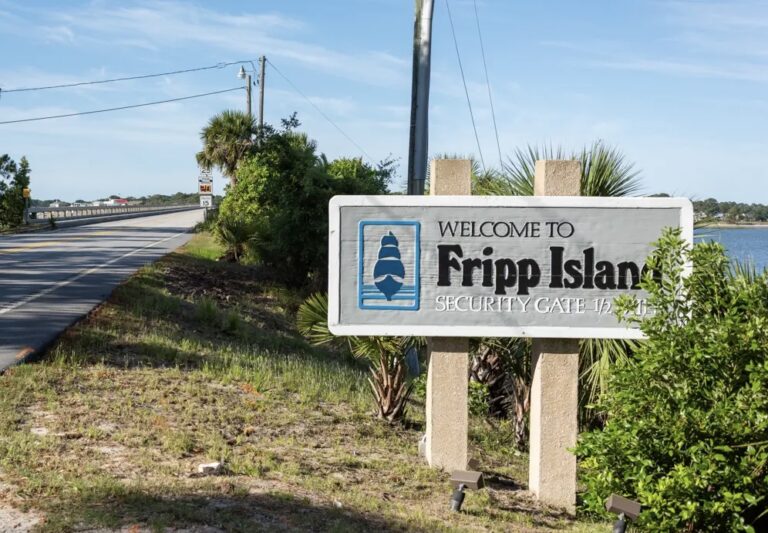
High Point University’s women team needed almost every bit of daylight Wednesday at Fripp Island Resort’s Ocean Creek Course near Beaufort, South Carolina.
Anaïs Arafi of HPU beat Breanna Hoese on the fourth extra hole in the deciding match as HPU edged UNC Asheville 3-2 in the championship round of match play.
Arafi rallied from an early three-hole deficit against Breanna Hoese to extend the match. She eventually won with her fourth consecutive par in extra holes.
Earlier in the day, HPU, which grabbed the No. 1 seed by winning the stroke play portion of the event, knocked off Charleston Southern 4-1.
HPU’s other victories in title match came from Makayla Grubb, who beat UNCA’s Lauren Madson, 8 and 7, and Eva Lye.
HPU junior Anna Howerton of Winston-Salem finished 24th in the three rounds of stroke play and split her matches, winning against CSU and losing 2 and 1 to UNCA’s Pennie Osterberg. Howerton made an eagle on the par-4 13th hole in her loss.
At 1-under, Caroline Patterson of UNCA was the only player under par in stroke play. Grubb was second at 1-over.
Wake Forest was a victim of ACC expansion over the weekend at the ACC Women’s Championship.
Newcomers Stanford and Southern Methodist claimed the top spots at Porter’s Neck Country Club in Wilmington. Stanford won the team title in match play after defeating SMU in stroke play.
The Cardinal shot 33-under-par 831 on the Tom Fazio design and McConnell Golf property to beat Stanford by 11 strokes and Wake by 19, followed by Duke, N.C. State and North Carolina, which grabbed the final berth in match play. Paula Martin Sampedro of Stanford was medalist at 14-under.
Chloe Kovelesky led Wake with a third-place finish at 9-under. Teammate Macy Pate of Winston-Salem tied for 21st at 2-under. Emily Matthews of Mebane finished at 1-under for Virginia Tech.
(This is the first of a new weekly feature on TriadGolf.com. Each weekend, editor/publisher John Brasier will share his experience that week playing at a Triad course open to the public.)
If you play golf and live in the Triad, you’ve almost certainly played the Champions Course at Bryan Park. The Rees Jones design, host of the 2010 U.S. Public Links Championship is one of the elite public courses in the region, and quite possibly, the best value I’ve found in the entire state.
But last summer when I last played Champions, there was some maintenance underway. So, this past week was a good opportunity to check out the progress.
The timing wasn’t perfect. The Bermuda greens had not totally recovered from aeration and the fairways were in transition, most areas offering tight lies and a mixture of dormant grass with new Bermuda only starting to grow in.
Still, it was a good experience. The back nine, which stretches along Lake Townsend is beautiful and challenging.
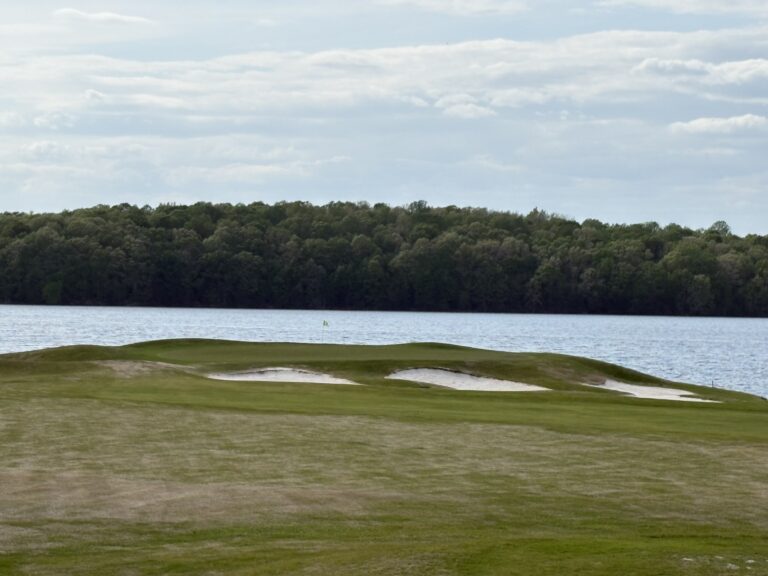
Some good news at No. 11, one of memorable holes along the lake, there’s new healthy grass on the small hillside where many players aim off the tee to cut distance on the sharp dogleg right peninsula.
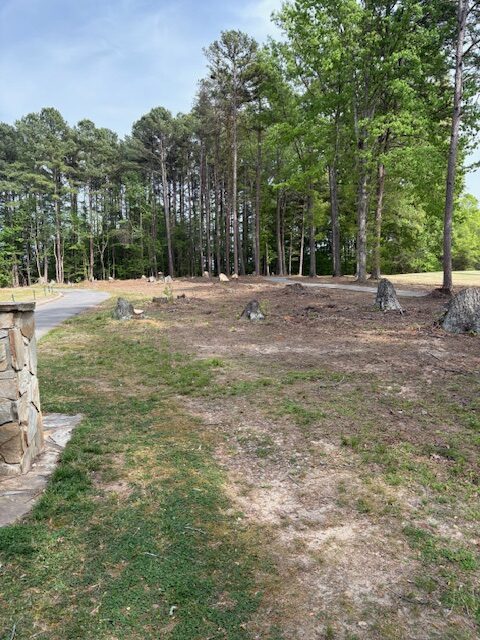
You’ll also notice a few dozen stumps where trees have been taken out left of the 11th tee. Renovated bunkers with bright white sand also added beauty and playability to the hole. I do hate the curbed cart path that forces players to walk 70 yards with multiple clubs to get to their ball.
Several trees were recently cleared near the 11th tee at Bryan Park Champions.
I don’t know why, but I normally play the back nine well. This week, my highlights were solid approaches into the wind to make easy two-putt pars at Nos. 12 and 14, which measured 175 yards and 190 yards, into a two-club breeze.
As much as I love most of the back nine, I hate the tricky, par-5 15th, which requires a tight drive into the wind over a sliver of the lake with no easy second shot options and limited good looks at a hilltop green hidden by trees for the first two shots.
After pitching out from the left woods, I hit a 3-wood over more water that rolled through the green, leading to an eventual 7.
For those that haven’t played Champions, it’s a great test of golf if maybe a little too difficult for beginners. My early weekday afternoon round took 3 hours, 30 minutes. I wouldn’t depend on that pace in the mornings or weekends.
As a senior, my cost was $45 for greens fee and cart. Greensboro residents also get a few dollars off. The highest price on weekdays is $63 Monday through Friday and $74 on weekends.
The superior practice facilities, including 20 new covered bays with Toptracer technology, are the best among area public courses.
In a few weeks, the greens should be smooth and fairways lush with green Bermuda. For good public players, Champions merits a spot in your regular rotation. If it’s booked up, the sister Players Course, is a solid alternative.
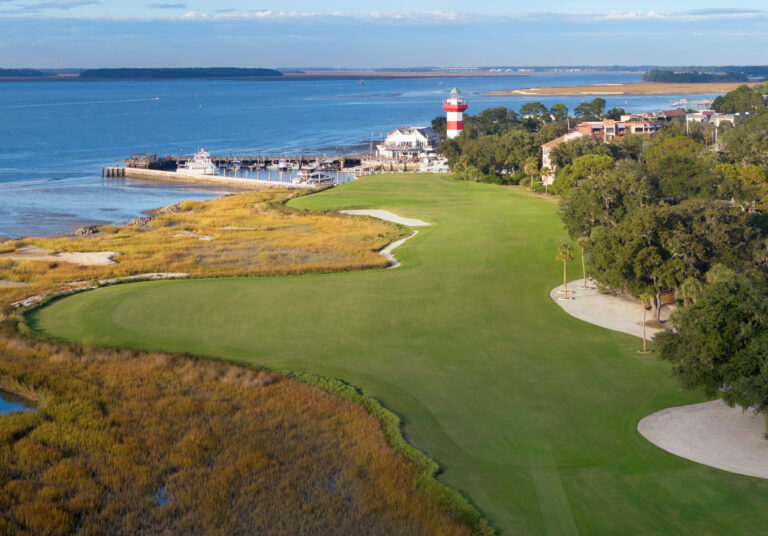
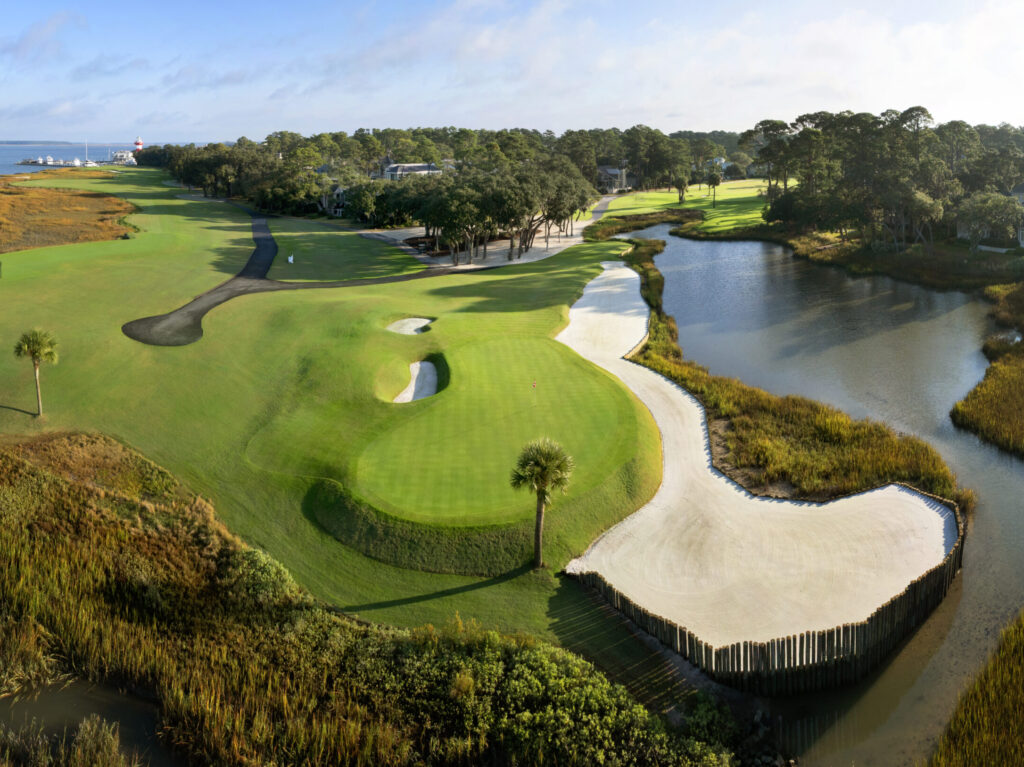
With its landmark, red-and-white striped lighthouse standing only yards behind its 18th green along the Calibogue Sound, Harbour Town Golf Links has long been a beacon of golf in the Carolinas.
Now, approaching 60 years old, the Pete Dye/Jack Nicklaus design reopened in November on Hilton Head Island after a subtle, but effective facelift from a fitting course doctor, Davis Love III, five-time champion of the RBC Heritage Classic, an annual upper-tier event on the PGA Tour.
TriadGolf.com visited Harbour Town in December hoping to see much the same classic layout, with minimal tweaks. I’d been fortunate to play the course perhaps a dozen times previously in media outings to promote the Heritage.
We weren’t disappointed. Harbour Town remains the classic, seaside shotmakers’ course that debuted in 1969. But with new infrastructure.
The routing and strategy for the holes remained much the same. This renovation didn’t include large-scale tree removal. Hitting fairways still isn’t enough — approaches often requiring hitting the target area in the short grass.
Bulkheads for greens set above hazards and bridges were rebuilt. New irrigation was installed. Railroad ties for the bulkhead was replaced. Some shrunken greens and bunkers were rebuilt to original size and shape, restoring lost pin positions at modern maintenance standards. Stack-sodded bunker faces, replaced over the years, were restored.
Though slightly larger, the course’s trademark small greens remain TifEagle Bermuda with winter overseeding with Poa Trivialis and the fairways are still Celebration and 419 Bermuda replaced with Perennial Rye in the winter. For maintenance reasons, the stacked sod on bunker faces were synthetic turf, a change we didn’t notice on the course.Though known for requiring accuracy over power, par-71 Harbour Town plays to almost 7,100 yards with a 75.6 rating and 148 slope from the tips, with distance from other men’s tees measuring around 6,600 and 6,300 yards.
The 17th hole at Harbour Town requires a shot over marsh and sand that offer plays into a strong ocean breeze. Photo by Bill Hornstein/The Sea Pines Resort
So what changes come into play?
Well, a big live oak was uprooted and moved 20 feet or so left to tighten the approach on the right to the par-5 fifth hole. At No. 7, another tree was moved to provide a tunnel feeling on the tee.
The trio of windy closing holes remains truly special, a place to make longtime memories. After satisfying pars at the dogleg left, par-4 16th and the dangerous par-3 17th, I bailed out right away from the beach on my approach at the signature 18th and failed to get up and down.
Harbour Town isn’t a course many of us will play very often. The rack rate in December was around $500, tip not included, for forecaddies, who provide yardages that mitigate the inconvenience of the course’s cart path-only policy. Sea Pines Resort lodging packages can make the golf fees seem more palatable.
Sea Pines’ other two courses, Heron Point and Atlantic Dunes, have been transformed over the years from typical resort-style courses to more challenging, upper-tier layouts.
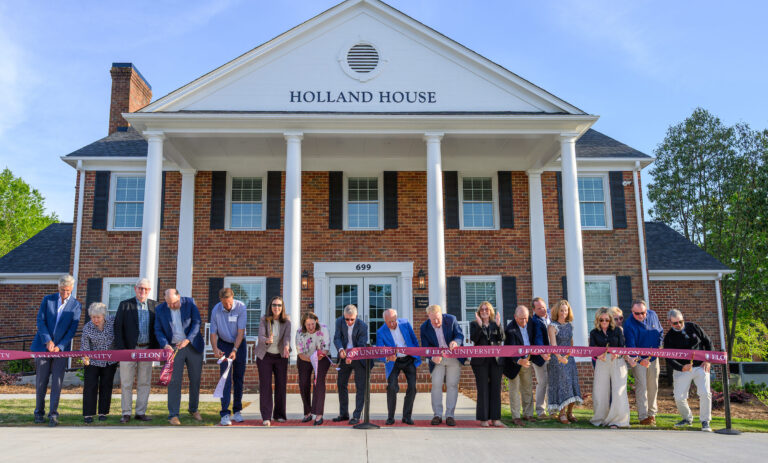
Elon University has reopened its Holland House as the home of its men’s and women’s golf programs.
Donors provided $3 million fir the expansion of the university’s golf complex, which includes the W. Cecil Worsley III Golf Training Center.
Holland House has new practice and team spaces, and state-of-the-art technology. The complex expansion project also encompassed renovations to the driving range, including the creation of a 17,000-square-foot tee box, and renovation of the short-game area with reconstruction of the bunkers.
Holland House includes locker rooms, coaches’ offices, quiet spaces for academic study, team engagement spaces and player meeting rooms, strengthening team culture and promoting student growth off the course.
The final phase of the project includes upgrades to the existing W. Cecil Worsley III Golf Training Center, a dedicated indoor practice facility that allows players to train in adverse weather conditions. The center opened in 2009 and includes multiple indoor heated hitting bays, a computerized swing analysis center, indoor putting facility and an outdoor lighted driving range.
Built in 1963, Holland House was the official residence for President Earl Danieley and his family along Haggard Avenue.